Showing posts with label Allen House. Show all posts

Tuesday, October 21, 2014

It's got nothing to do with politics . . .

I called my sister last week, on what is still unfortunately referred to as Columbus Day.  I asked her what she was doing.

“Paying bills, doing laundry, cleaning house.” 

“I’m taking the dogs to the vet,” I said.  Then there was silence. Contented silence.

Every year for the past twenty-one years I’ve called my sister or she has called me on Memorial Day and Columbus Day.  The routine is always the same.  What are you doing?  Not much.  You?  The usual.

This little ceremony is in memory of the twelve years we were innkeepers on Cuttyhunk Island, when the calendar from Memorial Day weekend to Columbus Day weekend meant our lives belonged 24/7 to the Allen House Inn.


Memorial Day weekend was the start of the season.  We’d scan the harbor anxiously, waiting for the boats to come in.  We’d praise sunny days and curse fog and rain. 
photo nina brodeur
And we’d wait both dreading and hoping we’d get slammed with too many people.We never had more than a  skeleton staff that early in the season, but we needed the cash.


We took out a startup loan at the beginning of every year, and breathed a sigh of relief when it was paid off and we began to make money.  We busted our asses eighteen hours a day, seven days a week, from the end of June until Labor Day.  
photo courtesy A. Hinson

Then the business dropped off as we headed toward the end of the season; but so did most of our staff, who had to get back to school or jobs or both.  The length of the day stayed the same, but our duties were more varied as everybody who stayed on took on any chore that was needed.


Then, finally, Columbus Day weekend.  That last grand slam of business, and the incredible relief with which we saw the harbor empty out on Monday.


A week of intense cleaning always followed, the scrubbing of every surface of the kitchen down to bare wood or metal, washing and bagging up linens, tablecloths, curtains, putting everything a mouse might want to chew into a container that hopefully a mouse could not chew through.  But that last week, difficult as it was physically, was incredibly satisfying emotionally.  We had made it through another season with our bodies and minds mostly intact.
photo A.Hinson
Almost twice as many years have passed without the Inn as the number of years we ran it.  I rarely have the dreams anymore, the ones where I wake up in a sweat because it’s Memorial Day weekend and things are not done.  My sister rarely wakes up wondering who is on the schedule to close at night.


But we remember.  We remember the good, the bad, the crazy.  As the years pass the good gets better and the bad slowly fades. 

And twice a year we call each other and talk about the lives we used to have, that we were so glad to have, and that we are so glad have moved beyond. 

We remember.


Tuesday, September 24, 2013

Don't panic . . .

This looks much harder than it actually is. Honest. Although it is a bit more work than, say, opening a can of cream of mushroom soup and pouring it over some frozen tilapia fillets. Not that there's anything wrong with that. (Although, actually, there is. It's just wrong, on so many levels.)

I digress. What a surprise. 

But you will probably save this to serve for a dinner party, where you want to thrill and impress your guests. Or perhaps a valentines day or birthday dinner for a loved one.
I'm betting it is fairly unlikely you are going to come home from work and say, "I think I'll whip up a nice striped bass en papillote for my supper tonight." 

Although you totally should. You deserve it.

Striped Bass en Papillote 
6 teaspoons unsalted butter, softened 
1/2 pound fresh spinach, cleaned and roughly chopped 
2 cups sliced asparagus 
½ cup thick sliced crimini mushrooms 
4 (6-ounce) skinless fillets of wild striped bass 
Kosher salt 
Freshly ground black pepper 
1/2 cup chopped parsley leaves 
4 springs fresh thyme 
2 medium shallots, very finely chopped (or ¼ cup fine chopped onion) 
1 garlic clove, very finely chopped 
1/4 cup dry white wine
Lemon wedges, to serve


 Directions
Preheat the oven to 350 degrees F. 
Fold 4 large square sheets of parchment paper in half. 
Starting at the fold, cut out a large half heart shape. 

Open the paper flat on a surface with the point of the heart towards you. 
Butter the centers of each heart lightly with a teaspoon of the butter. 
Divide the vegetables into four piles. 
Place a pile onto each heart, centering it on 1 side of the heart, towards the crease. Season the fish well with salt and pepper and place a fillet on top of each pile of vegetables.
Place 1 teaspoon of butter on each fillet and sprinkle each with some of the parsley, thyme, shallots, and garlic. 
Drizzle a little white wine over each. 
Fold the paper over to cover the fish. Starting at the top of the heart, tightly fold over the edges, overlapping each time, all the way to the point, until it is sealed. Tuck under the last fold to keep it closed.
Butter the tops of the packets with the remaining butter. 
Place the packages onto a baking sheet and put them into the oven for 15 minutes. 

You can do this on a pan on the grill if you want, but the cooking time is tricky. 
To serve, put the papillotes onto plates and unfold them at the table. (Be careful of the hot steam.) Serve with lemon wedges. 


 When I first began cooking at the Allen House in 1982, serving striped bass in the restaurant was a big deal. The years of fishing guides pulling in boatloads of fifty, sixty, even seventy pounders were a mere fond memory, leaving only pictures on the restaurant walls of huge catches filling skiffs and lined up on the fish dock.

But in the 70's strict regulations had been put into place concerning the size and weight of a “keeper.” Commercial fishermen were not allowed to catch striped bass at all. Only sport fishermen with rod and reel were allowed to catch and keep bass. And a special license was needed to be able to buy,sell,or serve striped bass. 
this is an example of a bass that should not be served.

 We were considered very lucky, as we had three striped bass fisherman working out of the Allen House. Any catch that was the proper size and over the customer’s limit they were allowed to sell to us. I don’t remember the exact size limits at that time but I believe at one point nothing under 40 inches was considered a keeper. And that is one big fish, especially when you consider the bass is a wide bodied fish. 
george is the only one of our guides from that time still fishing

The fishermen were required to bring us the bass whole, just in case somebody needed to check and make sure the fish was the proper size and weight. Since we had to accept them whole, Steve decided to turn this into a merchandising gimmick. He’d place the whole fish on ice in the raw bar out by the dining room. Then the first person to order striped bass got to watch Steve go out and wrestle a huge fish out of the raw bar and carry it into the kitchen to be portioned. 

Because we had to fillet on the fly, usually in the middle of at least two other dinner orders, I quickly learned the best way to gut, fillet, skin and portion a fish so large it took up half the work space in our tiny kitchen. I also spent a lot of time after service was over cleaning scales out of odd places where they’d flown in the heat of battle. 


Our restaurant was, at that time, one of the few places where you could almost always be assured of being able to order striped bass, and over the years we became famous for it. even as the striped bass population slowly increased and the fish became easier to acquire and serve.
Duane and Tyler


Thursday, August 22, 2013

The more things change . . .


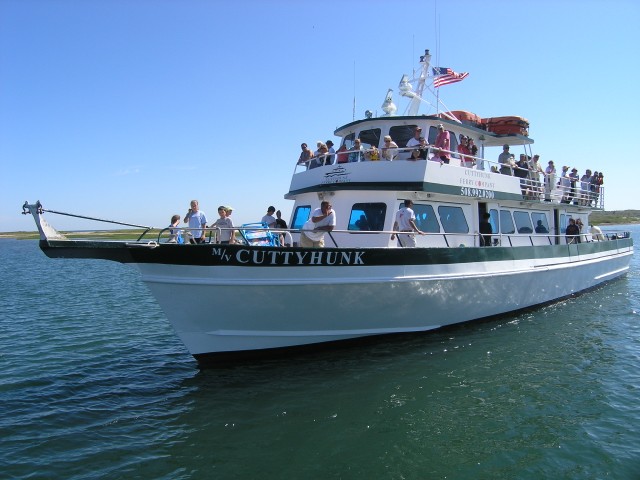
MV CUTTYHUNK

FERRY ALERT

the more things change. 
WEST END LIGHT HOUSE  AND COAST GUARD

COAST GUARD HOUSE AT FERRY DOCK

POST OFFICE

POST OFFICE CIRCA 1890'S

CHURCH AT TURN OF CENTURY

CHURCH TODAY

Yes I know that’s not the way the adage goes, but I’m rewriting it.  At least for now.  I’m in the middle of my last week in what used to be my apartment on Cuttyhunk Island.  The building is a rental now but I took the downstairs for the entire summer because I wasn’t ready to say goodbye yet.

Now it’s time.  
We brought a few things home in the car after our July visit, (my dad's fishing pole, a couple of pictures, a few mementos) and I have to decide what to leave (besides a couple of boxes of my books) in the blue tote that’s going to stay in my sister’s basement.  One tote.  Mostly filled with books.

There is nothing I can’t leave behind left in the apartment.  Anything I couldn’t bear to never see again has already gone to our new house in Virginia.  All I’m dealing with is the practical; what would I really like to have in whatever place I stay in next year?  

When I rented back my apartment this year I thought I’d be spending the whole season here, spring summer and fall.  I hadn’t planned on suddenly ending up with a house in the middle of Lexington Virginia that needed furniture and fences and decks and porches and so on.  The upshot is, I haven’t spent much time here in the summer.  Not nearly enough.

And yet I’m not taking this place again next year.  I’m not going to tie myself down.  I probably won’t be here more than a few weeks anyway, to do a couple of readings and hawk my new book.
Surprisingly, I’m okay with that.  I think I’ve finally said goodbye to this house, and what living here meant.

  It gets easier, I find.  It took me years to say goodbye to the Allen House.


But things change, and change, and change again. 
the poplars at turn of century
The Allen House, now a private home.


 And you get used to it, hopefully.  And you move on.  Again, hopefully.  Sometimes you even grow a little bit.

When I left Cuttyhunk the first time I didn’t return for eight years.  This time, I’m not looking at it as leaving.

I’m just going to take a little break and try spending a summer in the valley I’ve called home for fifteen years.


What a concept.

Tuesday, August 20, 2013

So I’ve been reading . . .


a book about the New Bedford docks by Rory Nugent, and it started me thinking about my time on Cuttyhunk Island again.  Nugent’s book is called Down at the Docks, and it’s basically a history of the New Bedford waterfront through the eyes of a number of different people.

Although Cuttyhunk:Life on the Rock was first person anecdotal, many of the things I learned on the island I learned secondhand.  Sometimes third or fourth hand.  Way too many stories to put into one book, and of course there are always stories within the stories.  I’ve often been accused of telling a story by starting with the stories within the stories within the stories, which some people find much too time-consuming to listen to. 

I realize it is difficult to believe people such as these exist.  I have trouble believing it myself.  I mean, if you don’t know the back story and sometimes even the back story’s back story, how can you ever really understand what went on?  Of course, these are probably the same people who skip to the back of the book to see how it ends.  Heathens, I call them.

But I digress.  Astoundingly unusual for me, but it does happen.  

Back to the point – those stories that don’t get told.  What happens to them?
I can’t answer that from a philosophical point of view.  I didn’t take those classes in college.  
In my world the stories that didn’t make it into the book still get told to anyone who asks, some of them in conversation, some in letters or emails.  They used to make their way into poems, often slipping in without my knowledge or permission.  That happens a lot with poems.

But I don’t write poetry anymore.  

So where do the stories slip in?  Right now they’re sliding into my new series of middle readers.  Not the way they are told in my memoir, but pieced together like a quilt; a fragment from this story, a snip of that memory…
THE AVALON
 photo A. Hinson
WINTER HOUSE
 photo A. Hinson
THE ALLEN HOUSE

 (For example, in the book I'm working on now, 2nd in the Summerhood Island series, all three of these buildings have been morphed into one- The Sea Inn.)

A memoir should tell the truth, at least the truth as far as the author can remember it.

But fiction is made of a different cloth.  It can stretch in any direction, start out with a name or a place and weave more names and places from other times and other memories onto the beginning, into the middle, at the end, around the edges until you have something that resembles a place you have known, or a person you have met The end result is not like any place or anyone real.  Sometimes it's a quilt. Sometimes it's just a raggedy mish-mash. This is fiction.  This is what I’m writing now.  And I have to admit that the freedom  to invent, and re-invent - is lovely.

Monday, March 11, 2013

And Now For Something Completely Different . . .


I thought I'd post a recipe every so often that's from the Allen House but not in the book; with an accompanying anecdote. Let me know if you like it and want to see more, ok?


Mussles Diablo

  • 40  high-quality mussels
  • 1 cup olive oil
  • 1/4 baguette, sliced on the diagonal into eight ¼-inch-thick pieces
  • 2 tablespoons chopped garlic
  • 2 cups canned tomatoes with their juice, crushed
  • 1 teaspoon hot red pepper flakes
  • Kosher salt
  • 1 cup dry white wine or dry sherry
  • ½ bunch fresh flat-leaf parsley, stems removed and leaves slivered, plus more for garnish
  • 2 tablespoons extra-virgin olive oil, for garnish

  • ·  Clean the mussels by scrubbing well under cold running water and removing any beards. Drain well, transfer to a large bowl, and refrigerate. 
  •  
  • ·  Pour 1/2 cup of the olive oil into a shallow baking dish. Lay the bread slices in the oil and turn once to coat both sides. Toast the bread for 10 to 15 minutes, turning once or twice, or until golden brown and crisp. Transfer the croutons to a plate to cool. 
  •  
  • ·  Pour the remaining 1/2 cup of olive oil into a large sauté pan and heat over medium heat. Add the garlic and cook for 2 to 3 minutes, or until lightly browned. Add the mussels, tomatoes, and pepper flakes and season with salt to taste. Stir well and cook for about 15 minutes. 
  •  
  • ·  Add the wine and parsley, cover, and cook for about 3 minutes, or until all the mussels open. (Discard any that do not open.) 
  •  
  • ·  Pour the mussels and the sauce into a large serving bowl. Garnish with parsley and drizzle with extra-virgin olive oil. Stud the bowl with the croutons and serve.


When we made this dish at the Allen House, we tried to use Cuttyhunk mussels as often as possible.  I discovered Cuttyhunk mussels the spring I first came out to the island.  

 After Hunter and I finished work for the day, I would spend the remaining daylight hours wandering, following every deer path and dirt road to its end.  One day at low tide, while exploring the tip end of the spit of land upon which Mel Dorr’s house stood, I stepped cautiously out onto some seaweed-slick rocks to examine a tide pool uncovered by the outgoing water and spied among the barnacles a bivalve I recognized.  

 The previous year in Boston I had taken a shortcut every day from the red line T stop at Central Square to my second job at Adams lighting company in Inman Square.  This shortcut took me up a side street with a small fish market on it.  Since my two jobs barely covered my expenses in Boston, I was always on the lookout for cheap food, and the fish market often carried a sign in the window advertising mussels, 3 pounds for a dollar.  I quickly became a mussel aficionado.  

 The shellfish clinging to the rocks among the barnacles might not look exactly like the cleaned and packaged mussels from my fish market, but they were familiar enough to recognize.  I gathered several dozen of the largest and carried them back to the Allen House in my T-shirt.  That night I had my first taste of what really fresh seafood could taste like, and I was hooked. 

 On later walks I discovered the huge beds of mussels exposed on the rocks of the West End at low tide.  These mussels carried the equivalent of a crackerjack prize inside their shells; a tiny crab that when steamed inside the mussels provided a burst of salty flavor that to me, and to many others, was a real delicacy.

Want more recipes? Let me know. Got one to share? Post it here. And stay tuned for more completely different things.

Monday, March 4, 2013

Anywhere but here


It was 8.30 a.m. when I arrived at the MV Alert, a nasty gray morning that held the promise of a quickly brewing storm.  There were six of us at the beginning, huddled against the wind on the splintery wooden bench outside the office, but the two single day-tripping hikers quickly decided to take Captain Ray’s advice and “Come back on a better day.”

That left me, Mary Sarmento, and Jack and Gladys Ashworth. The youngest of them had a good fifty years on me. 

Brad still owned the Alert then, but Ray ran it most days, and would be running it that day, if he decided to run.
 He wasn’t sure. It might be too rough.

 He had a mail run, but it could wait a day. Could we? 

Jack and Gladys conferred for a moment, and announced they could wait. Linda called a taxi to take them to wherever they’d come from for another night.
Mary said she thought the ride would be just fine. But then, she’d gone from one island to the next in an open boat for 40 years.

You’d think I would learn, eventually. If the captain doesn’t really want to go out on the water, should you?

It’s not as though I like the sea, or boats, on calm and sunny days. I have the stomach of a two-year old who has overdone it on cotton candy at the county fair.

But even then, just a few years into the job, the transformation had begun. I was becoming one with the big grey building with the red roof. I was the Allen House.
And whatever was happening, if it was happening between February and October it couldn’t happen without me. Obviously. 

Mary settled into the tiny cabin with her knitting. I went up with Captain Ray, knowing the diesel fumes and heat in the enclosed cabin would sicken me in an instant. Ray opened the doors on both sides, then gave me a pair of bright yellow oilskins to wear for protection against the wind and spray. 

We cast off and headed out into Buzzard’s Bay. 

The boat had barely cleared the harbor when it became evident the sea was much rougher than even Ray had surmised. He looked down at me,  perched in the middle of the seat, uneasily clutching a paper bag to heave into, already wet from the waves lashing the boat. 

“Are you sure you want to go?” he asked. 

The radio squawked to life. Ray listened a moment to what was, to me, unintelligible gibberish.  He turned back to me.

 “Well, too late now,” he answered his own question. “They just closed the hurricane gates.”

What’s your worst, or best memory of the old Alert? Or any ferry to a remote summer spot?  Leave me your story in the comment box.