Sunday, March 9, 2014

I am taking . .

a short, last-minute but wonderful residency at VCCA, (Virginia Center for Creative Arts) and I’m torn.  

I keep bouncing between islands.  That is, I’m trying to work on the second of the Summerhood island ‘tween novels (which is set on an island suspiciously resembling Cuttyhunk,) and at the same time  trying to rough out the next couple of Antarctic blogs.  Which also happened to focus on islands although these are slightly farther south and even less populated than Cuttyhunk in winter.  

Unless, of course, you count the penguins. 


The ornithologist on board ship told us they were seventeen species of penguins, but although not all were in Antarctica and the sub Arctic regions, all of them were in the southern hemisphere.  So there probably won’t ever be penguins on Cuttyhunk or an island suspiciously like it.  Then again, there probably won’t ever be people on most of these islands that we visited, so I guess we’ll call it even.

After the Falklands we spent a couple of days at sea, getting lectures on every possible subject from explorers to climate change, penguins and skua’s and albatross,  fur seals, elephant seals, whales (which my voice program insists on spelling  Wales,) even a lecture on krill.  With perfect timing, we were called from the Wale (sic) lecture up on deck by the captain to see pilot Wales and fin Wales swimming around the ship. 


I won’t anthropomorphize them by saying there were cavorting, but they certainly appeared to be having as good a time as I was even though they weren’t taking any pictures.  Apparently Wales have better memories than we do and don’t require seven thousand two hundred and forty-six pictures to remember that this large steel thing with some sort of mammalian forms leaning over its sides was staring at them and making odd gestures during dinner time.


Our first stop on South Georgia Island was at Salisbury plain. If I’d realized I’d see  this many penguins up close

 I don’t know that I would’ve taken as many pictures of faint penguin specks in the distance on the Falklands.

 
Here were our first king penguins and we saw them by the hundred thousands. 


Kings look just like emperors only smaller, which is good because emperor penguins reside deep inland on the Antarctic continent.  Just a few newly hatched chicks here,

but some kings sitting on eggs 


and a great many first-year chicks who were molting their downy brown feathers for that sleek, waterproof black and white coat that enables them to move like bullets in the water towards prey and away from predators. 
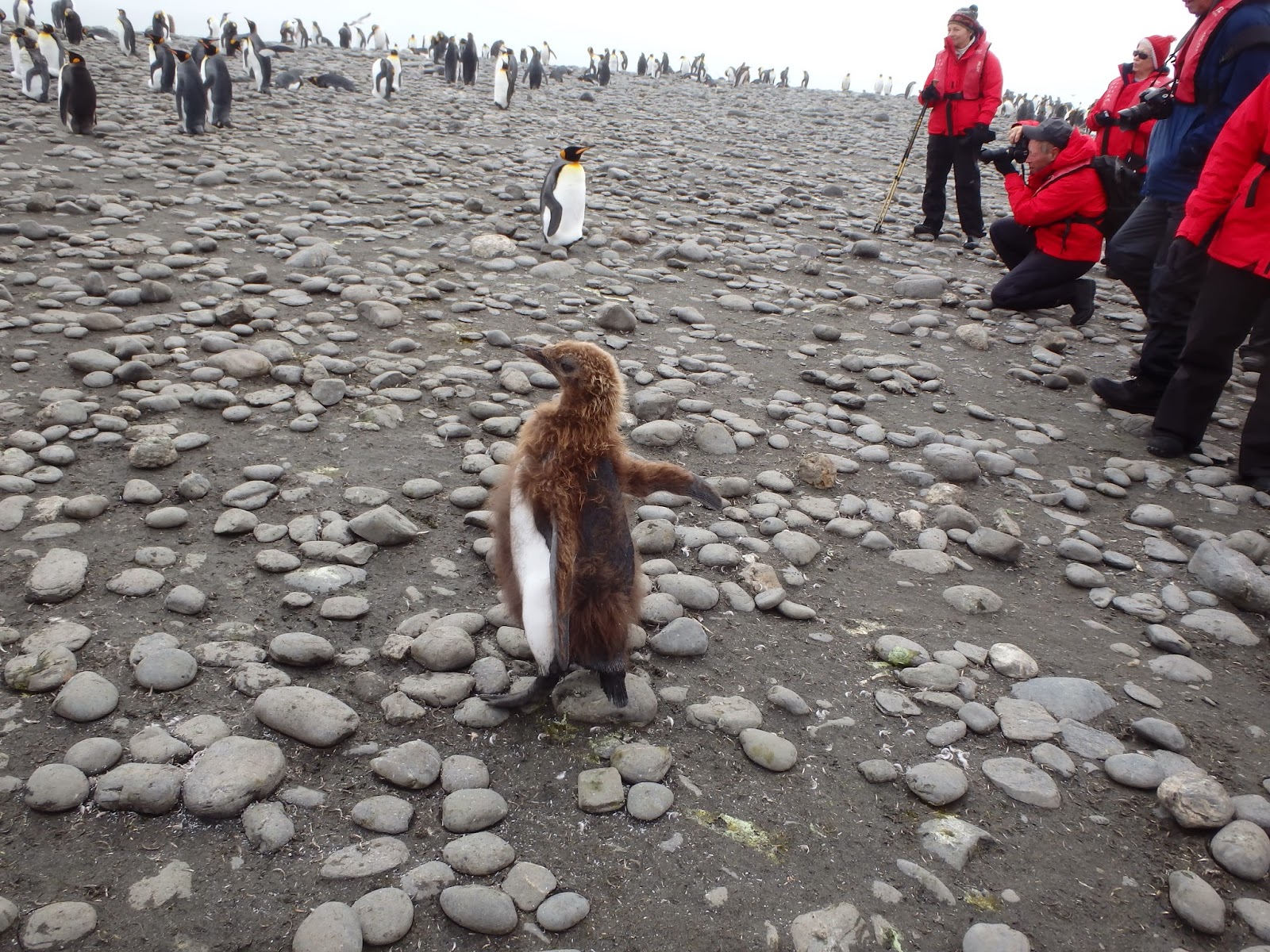


favorite photo bomb of all time


This is also the time of year that king penguins do their catastrophic molt.  Basically they stand still for a week and do nothing but lose feathers as a new coat comes in.


There were also tons (literally) of seals. 

Mostly fur seals of several generations,

 but a few elephant seals as well.  

And you know how cute and adorable and sweet those little fur seals are?
Not.  Well, maybe they are cute and adorable, but they are not sweet.  As Susana put it, they wake up cranky.  And it goes downhill from there. 

And here too, we found that neither birds nor animals obeyed the 15 feet/15 m rule about contact.  Which was fine with penguins,
but caused some interesting backpedaling from angry seals.  For some reason, as I guess is true in every culture around the world, the adolescents were by far the most pissed off.


I know it’s been ages since I gave a recipe, but this is an Antarctic blog.  If you’d like, after the next blog which deals with the excitement of a death march and a whaling station (oh be still my beating heart) wI ill give you a recipe from a book I read before I left entitled Hoosh.  Would you prefer penguin breast in port wine sauce or saddle of sea lion?

Tuesday, March 4, 2014

Now the fun really begins . . . .


(Yes, we are still in Antarctica. But if you are willing to read to the end of the blog, there will be a surprise for you. No cheating.)

Our first landing was on one of the Falkland Islands. Bleeker Island. Silly me, I’d thought we might go into the town of Stanley and walk around, maybe meet a Falklander or eat some Falkland food. I’d even read up on the currency to make sure they took U.S. dollars. (the official currency of the Falklands is the euro, in case anyone reading this gets on Jeopardy).

Well, I am here to tell you that if penguins 
and fur seals 
had any restaurants or souvenir stalls open, they were not on our side of Bleeker Island.  So I did not have a chance to use my newfound currency knowledge.  Nor did I have a chance to use any currency for the next week, as we never really saw another human being, unless you count the sheep farmer who kindly ferried a few of the more infirm passengers several miles across one section of the island  
no, this is not the farmer, just an indication of the distance. the blue pants belong to my sister nina. the rest of the body on top of the pants also belongs to my sister nina.
so they could climb up to a rockhopper colony.

  Now I’m not saying this guy didn’t count as a human, but I didn’t talk to him, so he doesn’t figure in my tally of mammals.
So, no souvenirs.  Unless you count the pink and white cowrie shell, the penguin bone, and the skua feathers I somehow found in my pockets upon returning.

Oh, come on, it was the Falklands.  And we didn’t get the lecture about not taking or leaving anything any place we stopped until after we left the Falkland Islands.  I’m sure of that.  Well, pretty sure.
Anyway, we saw Magellan penguins in their underground burrows.  
 We saw our first skuas, 
and I actually got a picture of a fledgling, 
which I was later told was quite rare.  We saw Gentoo penguins
 that we wouldn’t see again until we hit the Antarctic Peninsula, quite a different climate from the Falklands.  We saw a huge colony of blue-eyed cormorants.

And on our afternoon stop we pulled up onto a rocky beach and walked several miles to a series of steep rock outcroppings.  When we climbed to the top of those we were rewarded with a rookery of rock hopper penguins.


rockhoppers have to go down a steep rocky cliff(hence the name) and come back with a belly full  of fish for their chicks. so you can't get in their way, because they don't have the extra energy needed to walk around you.


And standing there in the middle of the rock hoppers on top of a large boulder was the only macaroni penguin we would see the entire trip.

Even though macaroni penguins are some of the most prolific in Antarctica, this guy, totally out of his element among the rock hoppers, was it for our sightings.
Not a bad first day of excursions from Le Boreal.

And for those of you who read (or at least skimmed) down this far, congratulations!
You’re the first to know that I finally heard from my publisher and my 'tween novel Coyote Summer will be out in 7 to 10 days. 

 And (shameless self-promotion) check out my ever changing and improving website www.margosolod.com for updates and the best ways to get Coyote Summer into your library or school district.


Tuesday, February 18, 2014

Antarctica in depth (bad pun intended . . .)

Those of you with no interest in Antarctica, please bear with me. I will alert you when there is a subject change and you can begin to follow along again.

I open the cover of my Antarctica Journal and flip past a few pages of images scissored from the brochure and glued in by my wife Deborah.  They meant nothing to me when I first opened the Journal at my home in Virginia.  Now I can see myself on that zodiac raft,
I am actually in the other zodiac taking this picture
 imagine myself taking a picture of the ship back-dropped by a glacier.


On the next page she has glued the official clothing checklist.  Those same clothes, carefully checked off the list at home, now lie clean but battered at the bottom of my office closet.  Most of them I will never wear again.  Perhaps someday I’ll let them go, but not yet.


admit it, i'm stunning.

Pages of baggage claims, receipts, ticket stubs; and then on the next page the small cardboard folder containing a plastic card.  It is the key to my room, my on board charge card, my ID, my expedition pass.  But it does more than that.  It opens the door to twenty-one days I will never forget, a time I can relive in memory for the rest of my life.  I run my finger over the red dot which proclaims I am a member of the Endurance group.  The Discovery group has green dots.  We are named after Shackleton’s ships.  We are explorers.
I have taped the ships itinerary and newsletter at the beginning of each day’s entries.  The first thing that catches my eye as I look at the handout for Wednesday, January 8 is the notation in the upper right-hand corner.  Sunrise: 4:43.  Sunset: 21:29.

I flip past the itinerary to the first couple of pages I have written.  Oddly enough, the first entries are all about my inability to get coffee at five in the morning, and the fact that there is no reliable Internet.

Sometimes I amaze myself.  How incredibly privileged I am to be on a journey like this, and these are my first comments.  Soon I will learn how to work the coffee machine behind the bar on deck three, aided by a few of my fellow early morning caffeine seekers.  And I will learn that the Internet, far from being unreliable, is in fact, damn near nonexistent.  As is the ability, promised to me by Verizon when I bought a new phone specifically for this trip, to text. 

I am essentially cut off from any world but this,

except in case of emergency or by lucky chance for a moment or two.  I am immersed in the now, as I was when I traveled alone twenty-five years ago, crossing and re-crossing North America in my truck, no cell phone, no internet.  How quickly we forget.

My first morning’s coffee is interrupted by a sound which will soon become very familiar, but which will never lose its ability to excite me.  The soft, sweet Brazilian accented sound of our expedition leader Susana’s voice: “This is Susana from the bridge.  I have checked out our first landing site 

and it is, I’m afraid, too rough.  However, we have another plan A, and the captain is going to raise anchor and move to another spot on the island.  This will take about a half an hour, and as soon as we drop anchor I will be going ashore with the expedition staff to check out our landing.  Please enjoy your breakfast and I will be in touch with you soon.”


This is the only time in our entire trip we will not be able to make the expected landing.  As Susanna has remarked and will repeat many times during the voyage, there is never a plan B if plan A is not possible.  There’s always another plan A.  She may be right, for I am never disappointed in any of the carefully planned landings that we make during this trip.

(stay tuned. more to follow in the days ahead.)


Wednesday, January 29, 2014

The rumors are true…


I have (albeit somewhat reluctantly) returned from Antarctica.


And it was absolutely everything that I had hoped for, and much more.


I’ve rediscovered some surprising things about myself, things I had forgotten in these years I’ve not been able to travel like I used to years ago, months alone in the truck, crisscrossing the continent, sleeping in campgrounds, cheap motel rooms, the side of the road.  Belatedly, I remember now how I could forgo any real contact as long as I could speak to a stranger, a waitress, a campground clerk, or turn on the distraction of the weather channel.  This was in those years before cell phones and Internet, when you could truly lose yourself away from friends and family.


It’s been a long time since I traveled that way.  In the interim, advances in technology have made it near impossible to stay out of contact, and I too have changed, unable now to simply jump into a vehicle and take off for months at a time.


We boarded the ship 


at Ushuaia in Tierra del Fuego


 and set sail for the Falkland Islands.  But to my surprise, we did not dock at Stanley or any other town.  In fact, we never docked the entire trip, instead dropping anchor in bays, off islands with Penguin rookeries,
fur seal breeding grounds,

elephant seal molting wallows.


And for days at a time, we were at sea, with no land in sight. 
No tv, and a patchy, sporadic internet that let you connect after an hour of failed attempts, only to kick you off moments later.


Just the ship and the water and the sky. 
A surprisingly emotional experience. Although I was traveling with two friends and one hundred and seventy-eight strangers, I was cut off from the world.  What did this mean?  It meant I was out of control.  Completely.  And that was a feeling I had three weeks to understand, to come to grips with, and finally, to embrace.


My trip to Antarctica was an amazing journey both internally and externally.  I saw wildlife I never thought I would see, set foot in places I had only read and dreamed about. 

But Antarctica was more than a continent at the end of the world for me.  It was more than the fulfillment of a lifelong dream.  It was an intimate, daily reminder of how much and how little I have grown and changed.  Antarctica was a teacher, a guide.  This trip was a precarious passage through broken ice flows that threatened to freeze me,
over mountains I had forgotten I needed to conquer.  I was constantly in awe, and I will forever be grateful.


Thank you Antarctica, my long anticipated friend and now constant companion.

https://mail.google.com/mail/images/cleardot.gif